Bits and Pieces #2 – Being Patient

While looking through the National Library’s Trove Website for newspaper articles on the Tasmanian potter Maude Poynter I came across an article from the Mercury dated April 5th 1924 describing an exhibition of Miss Poynters works at Hobart Town Hall.

The article goes to great lengths to describe the works on display by both Miss Poynter and Miss Mace (Violet Mace) that it really makes you wish they had taken a photo or two. Particularly of the Mah Jong set created by Miss Mace (where is it today?!!!).

One thing that struck me though was that in 1924 Miss Poynter was planning to upgrade to an electric furnace once the wires finally reached her home town of Bothwell in Tasmania. This struck a particular chord with me as a recent migrant to a semi rural part of the Apple Isle who is currently waiting on a cable (albeit a different kind of cable) to arrive in our town.

The modern day cable I speak of is the the long awaited roll out of the Government’s National Broadband Network (NBN). The first stage is complete and the lucky few at Midway Point have had their services switched on and are already enjoying high speed internet goodness. From what we can tell Kingston is next on the list for the roll out but that’s still more than 40kms “down the road” from us so we aren’t holding our breath for connection any time soon.

However, we do have an internet connection, we just want a better one. We don’t have to make do or find alternate ways of doing our business it just takes a a couple of seconds longer (or minutes depending on if the fog is blocking our wireless signal) to get things done compared to out big city counterparts or indeed the lucky few at Midway. I don’t know how we would cope waiting for something as important as electricity to makes its way this far south.

A year later though Maude returns to Hobart to hold another Exhibition with Miss Mace and in the Mercury article dated March 25th 1925 it is noted that “in view of the near approach of the supply of power to Bothwell some beautifully designed electric reading lamps were objects of special interest.”.   To put this into a little more perspective, Hobart had its first electric street lamps switched on around 1897. Even my old home town of Hurstville in New South Wales had power by 1910 and was working to get the lines as far south as Sutherland by 1912.

But still Miss Poynter waits…

In June 1928 however, luck finally turns Maude’s way and we see in the June 22nd edition of the Examiner the final approval for connection of electricity to the Ratho pottery at Bothwell was granted.

Maude Poynter moved to Ratho at Bothwell in 1918 and had to wait 10 years to get her lights put on!

If Maude can wait 10 years I guess I’ll have to learn to be a little more patient waiting for slightly better internet…

A photo of Maude Poynter at work in her pottery taken from the Mercury’s “Woman’s Realm” supplement dated October 16th 1935. Interestingly, Maude is still using her old pedal powered potters wheel. Hopefully she has the electric light on though!


References:

POTTER’S ANCIENT ART. (1924, April 5). The Mercury (Hobart, Tas. : 1860-1954), p. 6. Retrieved July 10, 2011, from http://nla.gov.au/nla.news-article23727479

GENERAL NEWS ITEMS. (1925, March 21). The Mercury (Hobart, Tas. : 1860-1954), p. 13. Retrieved July 10, 2011, from http://nla.gov.au/nla.news-article23805368

BOTHWELL COUNCIL. (1928, June 22). Examiner (Launceston, Tas. : 1900-1954), p. 8 Edition: DAILY. Retrieved July 10, 2011, from http://nla.gov.au/nla.news-article51484669

Photo of Maude Poynter http://nla.gov.au/nla.news-page1829281

Posted: July 10th, 2011
at 11:58am by Tim

Tagged with , , ,


Categories: Australian Pottery,Bits and Pieces

Comments: No comments


Mystery Potter #2 – Xella, Kella, K Ella

Standing 19cm high and measuring 21cm end to end, this amazingly detailed figure of a North American Blue Jay is another favourite from my collection, unfortunately it’s also a complete mystery!

Marked to the base either Xella 584 or X-ella (Kella, K ella, or K-ella) and bearing a Queensland “We Make it Great in The Sunshine State” sticker, this is either a very interesting piece of late 1980′s Australian pottery or a sticker swapping impostor.

Naturally, I’ve checked and double checked the books, I’ve googled furiously and e-mailed knowledgeable collectors, all to no avail.

Throughout my chats with collectors and dealers regarding this piece, one worrying constant keeps popping up. People keep asking me if I’m sure the sticker belongs to this piece? All I can say is that the sticker looks to be contemporary with the age of the item and also looks to have been in it’s current position for quite some time. I do believe it is Australian made from Queensland but do have to admit that this easily removable sticker is the only thing linking this piece to Australia and Queensland.

Scat pottery were producing similar, highly detailed figures of native and non-native birds in the 1970′s so it’s nothing we haven’t seen from Australian companies before.

The name Xella seems to be of French origin and means “From the Mountain Home”  which seems kind of fitting given the material used to produce this amazing bird.

If my Xella Bird proves to be an impostor I’ll be a little up upset but have to admit, no matter what the outcome, this little birdy still has a place reserved in the shelves of my collection. Granted though, if it isn’t Australian it might be pushed a little towards the back of that shelf. LOL

Posted: May 8th, 2011
at 9:10am by Tim

Tagged with , ,


Categories: Australian Pottery,Mystery Potter

Comments: No comments


Finds #2 – Diana Waltzing Matilda Jug

Now, I can’t say I have too many pieces of Diana pottery in my collection.

The number of Diana pieces that have made it onto the “Keepers” list is even smaller (I think seeing a bit of Diana’s Nefertiti stoneware everywhere has kinda put me off the brand. Having said that one of my other Diana keepers is from the Nefertiti range. But that’s a story for another day).

This jug, my most recent find, has most certainly worked its way onto my list of keepers and is fast becoming a favourite of mine.

Modeled by Tony Vacek for the Diana Pottery of Marrickville NSW in 1951, this jug stands a substantial 20cm high and is marked “D51″ under the first sheep’s head to signify the year of manufacture. There are 2 or 3 different colourways available and it is said that less than 1000 around 6000 were produced in the nearly 2 years they were in production. What the split was between colour variants I don’t know, safe to say they are all hard to find.

The jug has a recess in  the base for a musical movement which would have played Waltzing Matilda when lifted up. The movements were imported from Switzerland and were so expensive and difficult to obtain that many were sold half price without it, so it’s no surprise this jug doesn’t have one (if you have a spare movement or busted jug with a movement let me know, lol).

There is also a Waltzing Matilda musical mug as a companion to the jug which also came in at least 2 different colour variants. As these mugs and jugs are reasonably rare and highly desirable,  prices these days are substantial so make sure you have plenty of folding stuff in your wallet if you are chasing a complete set. It almost brings a tear to my eye to hear my Dad recall in the early 1990′s a friend had 5 or 6 of these jugs and couldn’t give  them away! How times have changed! What’s worse is the stories of how many Grace Seccombe animals my folks sold in the 80′s for next to nothing! Argh!!

Post Script: Thanks to Tony from the New Zealand Pottery Forum for pointing out Mirek Smisek’s involvement in the design of this jug. The following is an excerpt from the Mirek Smisek – 60 Years, 60 Pots exhibition catalogue:

“We made about 6,000. They were so popular; you have no idea. I did it with Tony Vacek, who was a sculptor. I designed the colour scheme. The colour was painted on, then rubbed off, so that it stayed only in the deeper part, which made it very clear, creating a sculptural feel. Two Czechs designing a Waltzing Matilda jug – the irony of it.” p9, Mirek Smisek – 60 Years 60 Pots,Mahara Gallery, Waikanae,2009

Mystery Potter #1 – Denise – Solved!

A short while ago I was contacted by a woman named Denise to let me know that the mystery potter referred to in my last post was none other than her Mother, Eileen Gunning.

Eileen started the pottery in her Burwood (Sydney) backyard naming it after her eldest child, “Denise”.

The wares produced were sold through the Princes Hotel and another long gone retail establishment which Denise can’t recall.

I tried to e-mail Denise for a little more information but the address she left isn’t working for me and I have not heard back from her.

Denise if you are still out there please contact me again as I’ve got a few questions for you.

So, that’s one mystery solved…..

Can’t be too many left to sort out?! LOL

Posted: May 1st, 2011
at 1:27pm by Tim

Tagged with , ,


Categories: Australian Pottery,Mystery Potter

Comments: No comments


Mystery Potter #1 – Denise

The little Koala ashtray shown below has sat in my cupboard for some years now, long forgotten and covered in dust. Purchased for only a few dollars, I wasn’t worried who made him even though he is signed.

Then, only a month or so back I found the Scottie dog ashtray shown below right by the same mystery potter.

There seems to be no mention of the mystery “Denise” in any of the noted text and a bit of sniffing around revealed I wasn’t the only one with a bit of Denise in the cupboard.

All  the pieces I have seen are certainly well made enough to suggest they are from a commercial enterprise of some level and dating from around the first half of the 1950′s.

I guess this shouldn’t be too hard to sort out, we are already half-way since they are all signed Denise. All we need is the last name. Should be easy right? LOL

If you have any idea who the mystery Denise might be or if you have a Denise in  the cupboard please leave me a comment below.

Posted: February 13th, 2011
at 5:37pm by Tim

Tagged with , , , , ,


Categories: Australian Pottery,Mystery Potter

Comments: 2 comments


Finds #1 – Essexware Pastille Burner

Well, it’s only taken me 7 years of collecting Aussie Pottery but last month I finally acquired my first piece of Essexware. I know it’s not the greatest example of what Essexware was capable of, but still a sweet little piece nonetheless. The piece was sold to me as an “Australian Pottery Pie Funnel” which made me chuckle a little I must admit. I have seen a few for sale in the past and they have been described as Pastille Burners or ashtrays. I think the absence of a “rest” for your ciggy quickly rules out the ashtray idea though.

Standing only 9cm high this piece is lovingly hand painted and fully signed to the base “Essexware Leura”.

According to Geoff Ford’s Encyclopedia of Australian Potter’s Marks (1st ed pg67);  Essexware was started in 1945 (somewhere between 1951 and 1954 is more likely though) by Gordon and Irene Dunstan in Leura NSW. The pottery was in operation until 1957 when it was completely destroyed by bushfire. The timing of the fire was unfortunate for Norm Sherratt who had quit his job with Diana and was due to start work at Essexware the week after the fire hit. Norm went on to work for Studio Anna for a short period before taking a job with Wembley Ware in Perth.

Some of the potters who worked at Essexware were Adele Durie, Rudolf Planter, Thomas Alban, Beverley Bray, Tony Priest, and Marjory Zabell.

While my little house is quite collectible, the most desirable pieces are covered in amazing Aboriginal themed artworks and signed by the Artists. At its best, Essexware stands tall even when compared to the best of the Boyds and Studio Anna.

For those interested in reading more about Essexware this is a a blog dedicated to the potteries, people and wares: Essexware Ponderings

The blog is unique as it shows many photographs of the potters at work and play in the late 1950′s. It’s great to be able to put a face to the name when so often in this area of collecting the name is all that remains.

My Favourite Pieces #2 – Remued 173 Jug

One of the few old pieces of pottery I have purchased in my first year living in Tassie. This Pamela/Remued 173 jug with a strap handle is certainly a stunner and an easy inclusion in my list of favourite pieces in my collection.

Standing just 9cm high and measuring 16cm from spout to handle this jug has a substantial look and feel despite it’s proportions. Displaying early Pamela colouring and an unusual strap handle it certainly doesn’t go unnoticed on my packed sideboard.

This piece is unmarked and unnumbered, which is not unusual for early Remued. The absence of a shape number along with the distinctive colouring and less pronounced spout seem to point to a 1933/4 manufacture date. This variant with a flat strap handle is not recorded on www.remued.com but a quick e-mail to Peter Watson revealed this is not the first he has seen. In fact he had seen several all of which are unmarked and unnumbered which is why he is hesitant to make the call at this stage. For me, however, there is no doubt especially given that other shapes appear on the website in the exact same colour scheme (see bottom left image on unnumbered PPP shapes).

Remued 173 Jug

Posted: October 16th, 2010
at 4:08pm by Tim

Tagged with , , , ,


Categories: Australian Pottery,Favourite Things

Comments: No comments


George Barsony 1917 – 2010

It is with much sadness that I announce that George Julius Barsony passed away 7/10/10 aged 93.

George, a Hungarian born sculptor and artist will be most remembered in collecting circles for his series of “Black Lady” lamps and figures produced from the 1950′s and into the 70′s.

Although George is gone his memory will continue to live on through the amazing body of work he leaves behind.

Posted: October 16th, 2010
at 1:52pm by Tim

Tagged with , , , , ,


Categories: Australian Pottery

Comments: 4 comments


Bits and Pieces #1 – Search Queries

Wow, I can’t believe it’s been over 3 months since my last post. I do feel a little ashamed but I have good  reason for it. In the last 3 months I have started a new job all while preparing for our new shed being built soon, which in itself has meant many hours of sawing, smashing, digging and jackhammering for us both!

Anyway, enough of all that and onto the topic of my first post in 3 months, Search Queries …

In reacquainting myself with the goings on of my website I was checking out the statistical data (number of hits, country of origin of the visitors, most popular articles etc). Among this overload of information, what I found most interesting was HOW people were finding my website on search engines like Google. Most come via rather simple searches like “Cula Pottery” or “Florenz Pottery”. Others, however, “ask” Google an entire question to find their way to my site like “How to value Australian Pottery?”.

So, I thought I would go through a sampling of these “questions” that helped people find my site and see if I can answer some of them for you all.

“Bakewell Newtone Date Range”

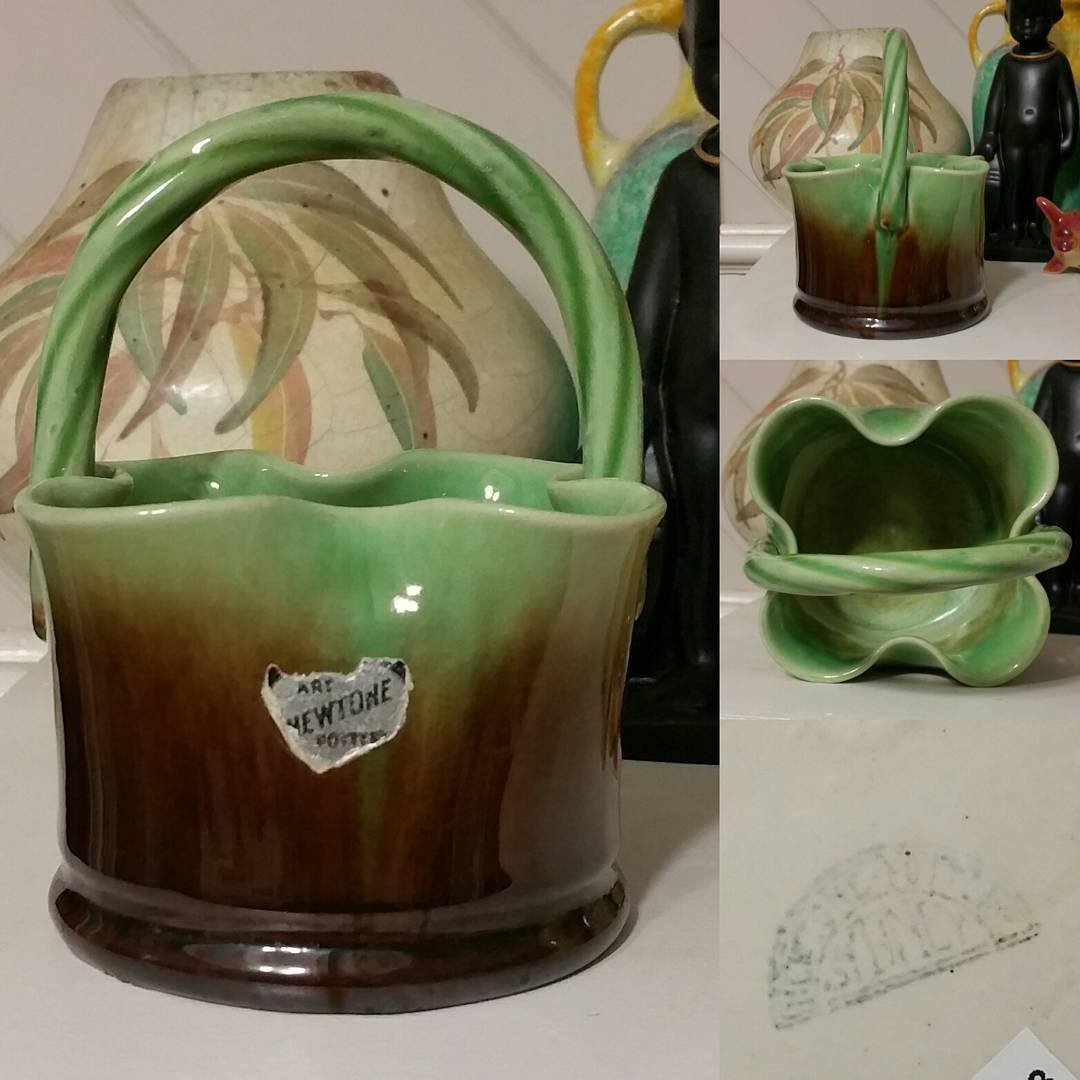
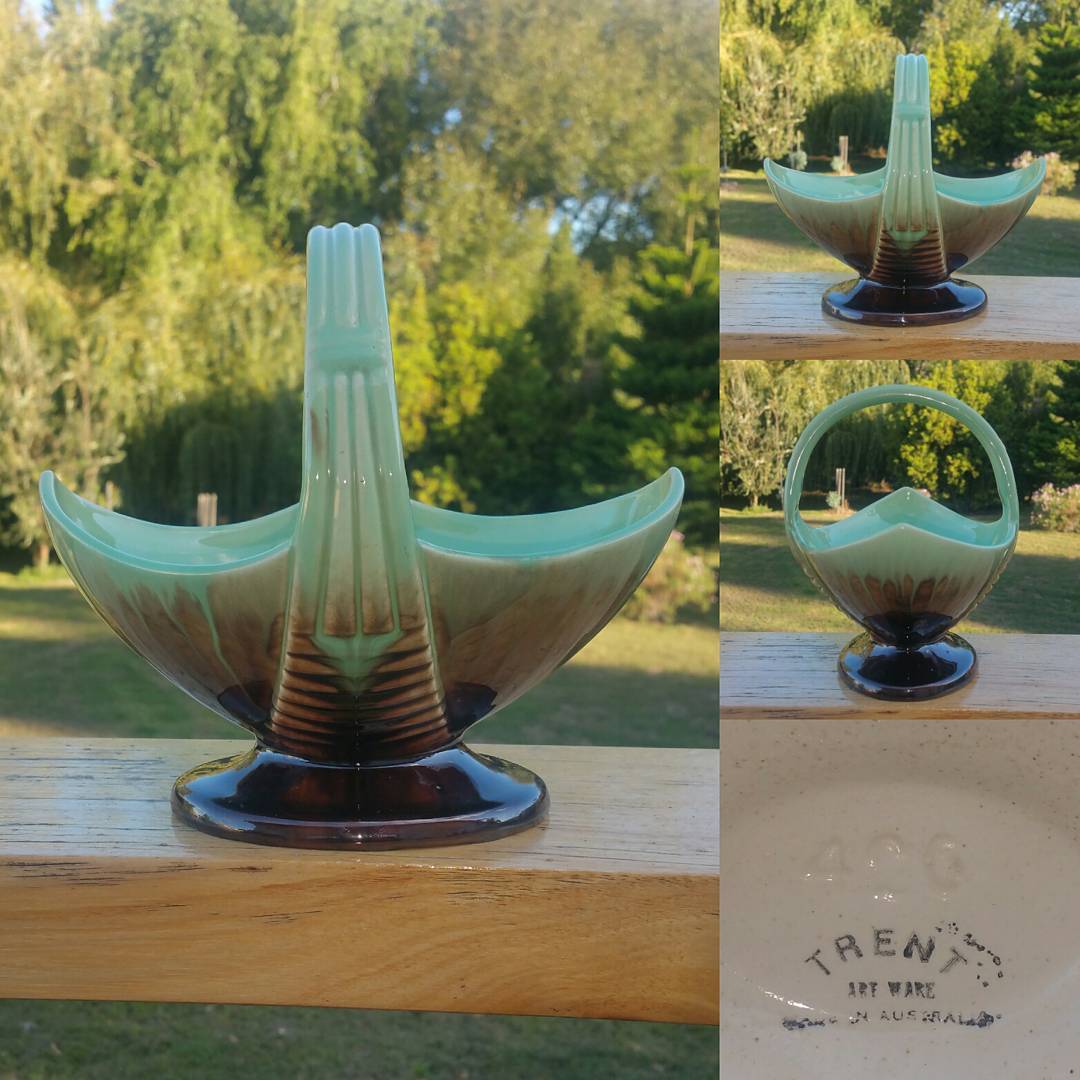
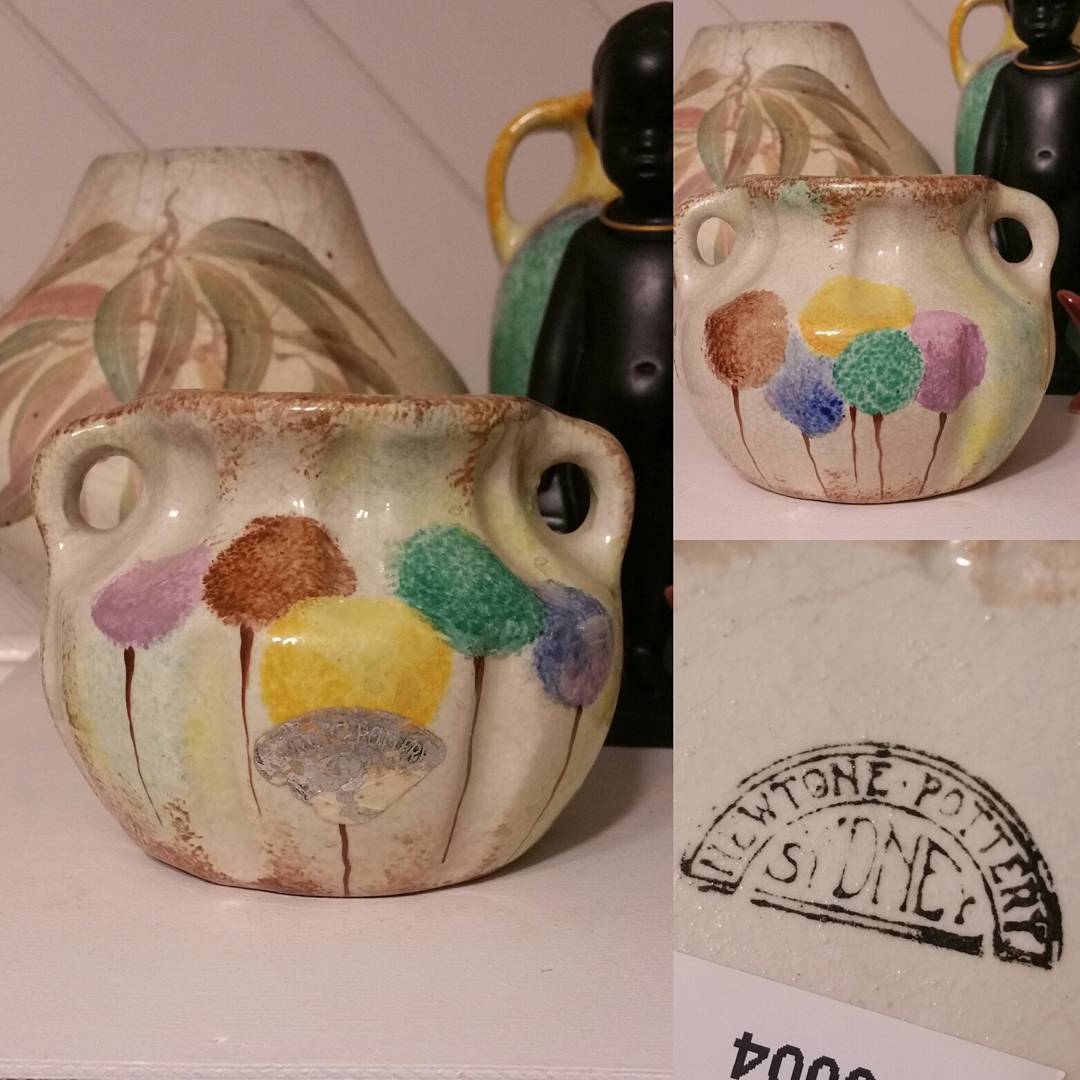
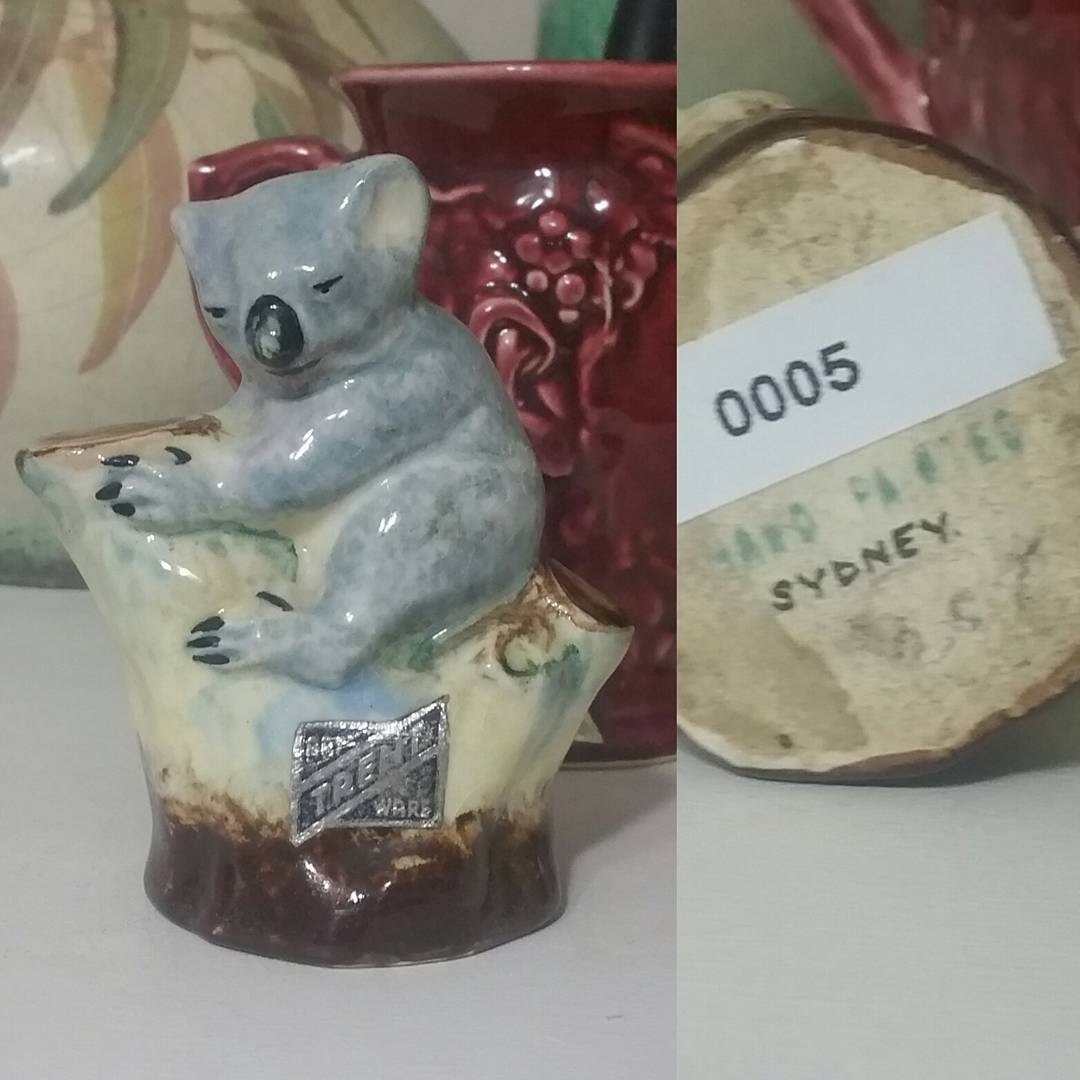
The “Newtone” range of art wares were in production from the early 1930′s until the late 1940′s (although I’m not sure much would have been produced during the war years). In the early 1950′s the name (but not anything else) of this range was changed to “Trent Art Ware”. Geoff Ford suggests that after the close of Bakewells in 1955 the Trent name and indeed line was continued by former employees in their backyard. At this point in time I’m not sure what, if any, of the old Newtone/Trent line was produced in that Bexley backyard as the mid to late 50′s Trent Art Ware pieces are unique to those years in production method, design, catalogue numbers and decoration.

Having said all that, as far as I know there are no factory production line Newtone or Trent pieces marked with a date so finding a more accurate cutoff point is a bit hard. I do have a workman’s piece of Newtone dated 1937 and a piece from Bakewells Beulah Ware line dated “Xmas 1938″ so it’s safe to assume those lines continued up to and past those dates.

“Everything about Trent Art Ware Pottery”

I don’t know everything about Trent Art Ware and what I do know is mostly written in the paragraph above. Information is very scant and the majority of the people involved are disappearing rapidly.

PLEASE, PLEASE, PLEASE, if you know anyone who worked for Bakewell Brothers or Trent Art Ware in Bexley or have any information on any era of production please contact me through this website as I am desperate for information!

“How to know if it is MCP pottery?”

I can only assume this is in regard to the Disney range produced by MCP in the 1950′s as for the most part, MCP is fairly well marked.

I have heard about people who can ID an MCP Disney piece by sticking their finger inside the drain hole and all manner of things. The thing that no novice collector wants to hear though is that at this point in time there is no easy answer and it is mostly research and experience which will ID an unmarked piece. There is some obvious colour differences between the American produced pieces and some models were only produced in Australia, which makes it easier. There is a blog compiling MCP Disney pieces which is by far and away the best visual reference I have come across in the public domain and it should be a great help to most.

“How to value Australian Pottery?”

A little bit of a how long is a piece of string type question …

Generally speaking though it’s like anything else – it’s a combination of factors that makes one piece worth more than another. For example a big misconception is that rarity alone makes something valuable. So, let’s knock that one on the head right now. There are plenty of very rare items that have no value at all because they just aren’t desirable or widely collected.

BUT, if you have a rare item by a desirable maker in good condition the outlook is a little rosier.

Good places to find out more about the value of your item for free could be the eBay completed items search or a reputable auction house.

“Newtone pottery the biggest hand painted vase”

The tallest hand painted Newtone vase I know of is about 11 inches or 28cm high (depending on how many candles are on your cake).

In fact 28cm is about the tallest Newtone vase I have seen full-stop and I believe this is about as big as they come. I have seen a hand painted vase by Daisy Merton which resides in the Merton family collection which stands about 50cm high but I don’t believe the work is on a Newtone blank like the majority of her Ceramic works.

“What is the difference between Studio Anna and Florenz Pottery?”

The short answer? Plenty!

I can only assume this query comes from eBay’s “Studio Anna, Florenz” sub category which to be honest is a complete mystery to me too!

Both companies had a long and distinguished career but to my knowledge were never linked.

Studio Anna (or more correctly Anna Studio) was owned and operated continuously under the same name by Karel Jungvirt and Toni Coles from 1953 to 1999.

Florenz has a somewhat more complex history starting with Florence Williams in the 1930′s and having a connection in its later stages with K.C. Industries (Casey Ware).

For more detailed information on both potteries see pages 44 and 70 of Dorothy Johnston’s “The People’s Potteries”.

That’s all I’ve got time for right now but hope I’ve been of some help to someone …

Out and About #1 – Saddlers Court Gallery

Last week, while entertaining some mainland visitors,  we decided to take the lovely drive out to the historic town of Richmond (about 30 minutes drive from Hobart) for a spot of lunch before  dropping our guests at the airport for  their long trip home.

On the way back to the car after lunch we managed a quick stop off at Saddlers Court Gallery for a look at some fine modern Tasmanian, Australian pottery. The gallery contains works by Derek Smith, Sue Stack, Panogana Pottery by Bill Thomas, Zsolt Faludi, and Mark Knight just to mention a few and is well worth a look if you are visiting Richmond. The Saddlers Court website also says they carry pieces by Les Blakebrough but I didn’t see any on my visit. Having said that I’m not sure how up to date their site is as they don’t mention Mark Knight despite a comprehensive  range being available in the gallery.

Set of Mark Knight Cannisters

Set of Mark Knight Cannisters

I will also mention that there is far more to see at the Gallery than just Tasmanian pottery. There is also an interesting selection of paintings, prints, art glass, large and small works in wood as well as jewelery. All up more than 100 different Tasmanian artists and crafts people are represented at Saddlers Court.

The gallery is open from 10pm to 5pm daily and will open after hours for organised groups by prior arrangement only.

« Older Entries